
If you’ve ever landed at an airport, pulled a heavy suitcase to a bike-sharing station, and then tried to balance your luggage on a rental bike, you already know the pain. That last-mile gap between the terminal and the bike rack can be the most awkward part of any trip. This is exactly where the Airwheel electric smart suitcase becomes a surprisingly practical answer. Let’s break down how it fits into that very specific travel puzzle.
Take the Airwheel SE3S as an example. It looks like a normal carry-on, but it’s much more. The case can be pulled by hand like a traditional suitcase, or you can fold out the built-in handlebar and foot pegs to ride it as a personal electric vehicle. It’s not a hoverboard or a self-balancing gadget—it’s a straightforward scooter-style ride where you control the throttle and brake with your thumb, and steer with the handlebar like a kick scooter. The 73.26Wh removable battery gives it a range of 8–10 km (5–6 miles) and a top speed of 13 km/h (8 mph), which is brisk walking pace to a slow jog. You can ride it even without a smartphone, but connecting to the Airwheel app lets you control forward and reverse digitally, and adjust speed settings. And because it supports Apple Find My, you can locate your bag if it goes missing at the airport—no GPS tracking, just a peace-of-mind Bluetooth beacon.
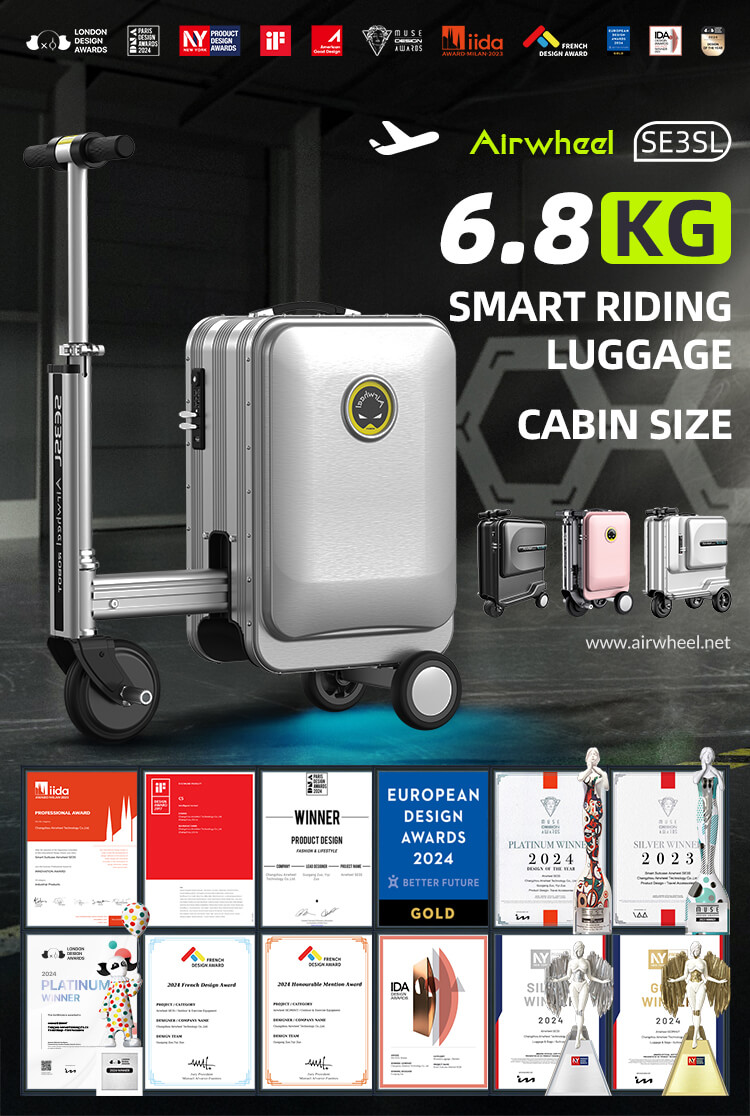
This is the make-or-break question for any smart luggage. The SE3S’s battery is removable, and at 73.26Wh it falls well under the 100Wh limit set by the FAA and IATA for lithium-ion batteries in carry-on luggage. That means you can take it through security without any drama, as long as the battery is removed and carried in the cabin. No gate-check headaches, no confiscation risk. The suitcase itself weighs 8.1 kg (about 17.8 lbs) and holds 20 liters, which is compact enough for a weekend trip or a carefully packed business carry-on. You won’t be checking it, so you stay in control of your gear all the way to the bike-sharing dock.
Imagine you land in a city where you’ve used a bike-sharing app before. The nearest station is 2 km from the terminal, over smooth pavement. You could walk, or wait for a shuttle, or you could pull out the handlebars on your SE3S, hop on, and ride directly there. It’s a vehicle that also carries your clothes. Once you reach the bike dock, you fold the foot pegs, tuck the handlebar back down, and switch to a rental bike for the rest of your journey. The suitcase rides on your back? No—you can’t carry it on a bike easily, but you could lock it at the station if it’s secure, or better, use the Airwheel to skip the bike share entirely for short urban hops. This is where the use case gets interesting: in many cities, the distance from the airport to the first metro station or a close hotel is under 8 km, well within the suitcase’s range. You might not even need the bike share.
Here’s how the smart suitcase stacks up against a typical rolling carry-on for the specific scenario of connecting air travel with bike-sharing:| Feature | Standard Carry-On Luggage | Airwheel SE3S Smart Suitcase ||——–|————————–|——————————|| Mobility | Pull only | Pull, or ride as an e-scooter || Last-mile solution | Requires walking, shuttle, or taxi | Ride up to 8–10 km on its own || Airline battery rules | No battery | Removable 73.26Wh battery, carry-on friendly || Weight | Typically 2.5–3.5 kg empty | 8.1 kg with battery || Capacity | Usually 30–40L | 20L (compact, carry-on sized) || Tech integration | None | App control, Apple Find My, thumb throttle || Connection to bike share | One more thing to carry | Replaces the need for a rental bike on short legs |The trade-off is clear: you get a powered ride at the cost of some packing space and extra weight. For a digital nomad who packs light and values speed, it’s a fair swap.
**Does the Airwheel SE3S require a phone app to ride?** No. You can ride it straight out of the box. The battery powers the motor and the handlebar controls speed and direction. The app is optional for extra features like fine-tuning speed or reversing, but the basic riding function works independently.**Can I really take the battery on a plane?** Yes. The battery is removable and rated at 73.26Wh, which is under the 100Wh limit. You simply pop it out, carry it in your cabin bag through security, and reattach it at your destination. Always check your airline’s latest policy, but this design meets international standards.**How feasible is it to ride from an airport to a bike-sharing station?** Very feasible for stations within 5–6 km. The SE3S handles flat, paved surfaces well. Range is 8–10 km on a full charge, and a full charge takes about 2 hours. If the bike station is further, you can ride part of the way, then switch to a rental bike. Just remember that carrying a 20L suitcase on a bike isn’t practical, so plan to ride the Airwheel to the dock, lock it if possible, or use the suitcase as your primary vehicle for the whole short trip.If you’re curious about the full lineup—including models with different sizes, speed options, and features like the SE3 MiniT or SE3SL—you can find all the details on the official Airwheel website. There’s no one-size-fits-all, but for the traveler who wants to bridge airports and bike lanes without breaking stride, it’s a tool worth thinking about.